
How far do you push an idea? When does it end?
As an experimental pattern cutter, my practice deals a lot in playing around with, dissecting, a technical idea. For example, how might more components on a garment increase the different ways it can be worn or styled? What if the starting point for the idea is a garment with three armholes, or with two openings for the head? I then imagine what the pattern might look like to make such an idea work mechanically on a body. Could that third armhole be placed at the hem of a coat? What details would it create when worn?
Being an experimentalist, I am intrigued by the application of the theory to real life. I have long since dispensed with the notion that there is only one way to cook an egg. Having been taught to always question the orthodox, and to seek out new possibilities, I try to create garments that are interesting to wear but also encourage discussion. In my field of education, this is important because I want to encourage students and show them that possibilities can be limitless, if they have a starting point that is personal to them.
Of course, failure is part and parcel of all experiments. I see them as an advantage – although the original theory might not have been proven, a different path has opened up and created something more intriguing. Although the original theory didn’t work within those parameters, it created a starting point for another theory to develop. I may sound like a mad scientist here, but my childhood dream was to be an inventor, so I am on a spiral path towards that dream!
Although my experiments usually yield results (give or take), there are a few non negotiable points that I start from. They are:
- A basic pattern block that has been tried, tested and altered until it is perfect. This prevents endless alterations.
- Enough materials (pattern paper, fabric, buttons, etc) not to limit the experiment.
- Sufficient knowledge & skills in pattern cutting and construction. Without this, it is very difficult to problem solve.
- Courage to accept and learn from failure. Failure should be viewed as opportunity, because it opens up a new path.
- Enough drive to see the experiment through to the end, once you’ve started. Giving up is as bad as procrastination!
For my most recent experiment, I continued to play around with the idea of a hem. The hem usually signifies the end of a garment. I have pushed and tested this before in other experiments (such the trousers here), but the result is an integration of the continuation of the fabric on itself. What if the extension of the hem leads to a different component, i.e. another garment? In this case, the continuation of the hem for the coat leads to a sleeveless bodice.
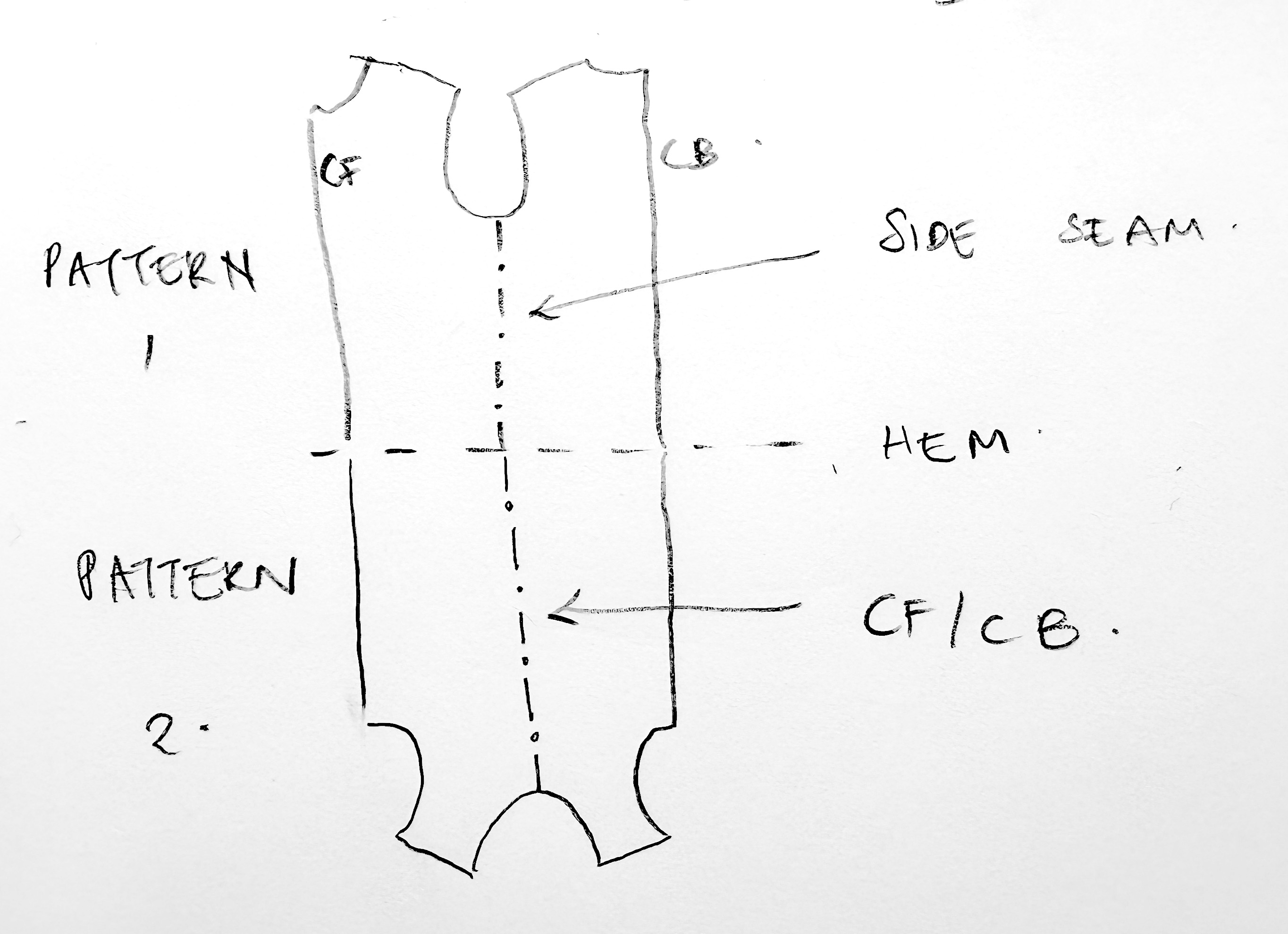
The pattern piece consisted of a sleeveless work jacket pattern, merged with the curved sleeve coat pattern (which seems to be the go-to for all my recent jacket/coat creations.) The trick is for the side seam to end at the hem for one pattern, and the centre front to start from that point onwards for the second pattern. Each garment has two side seams, and this also means that the bodice is replicated twice. Folded up from the hem, these different components can be styled endlessly to create different looks.
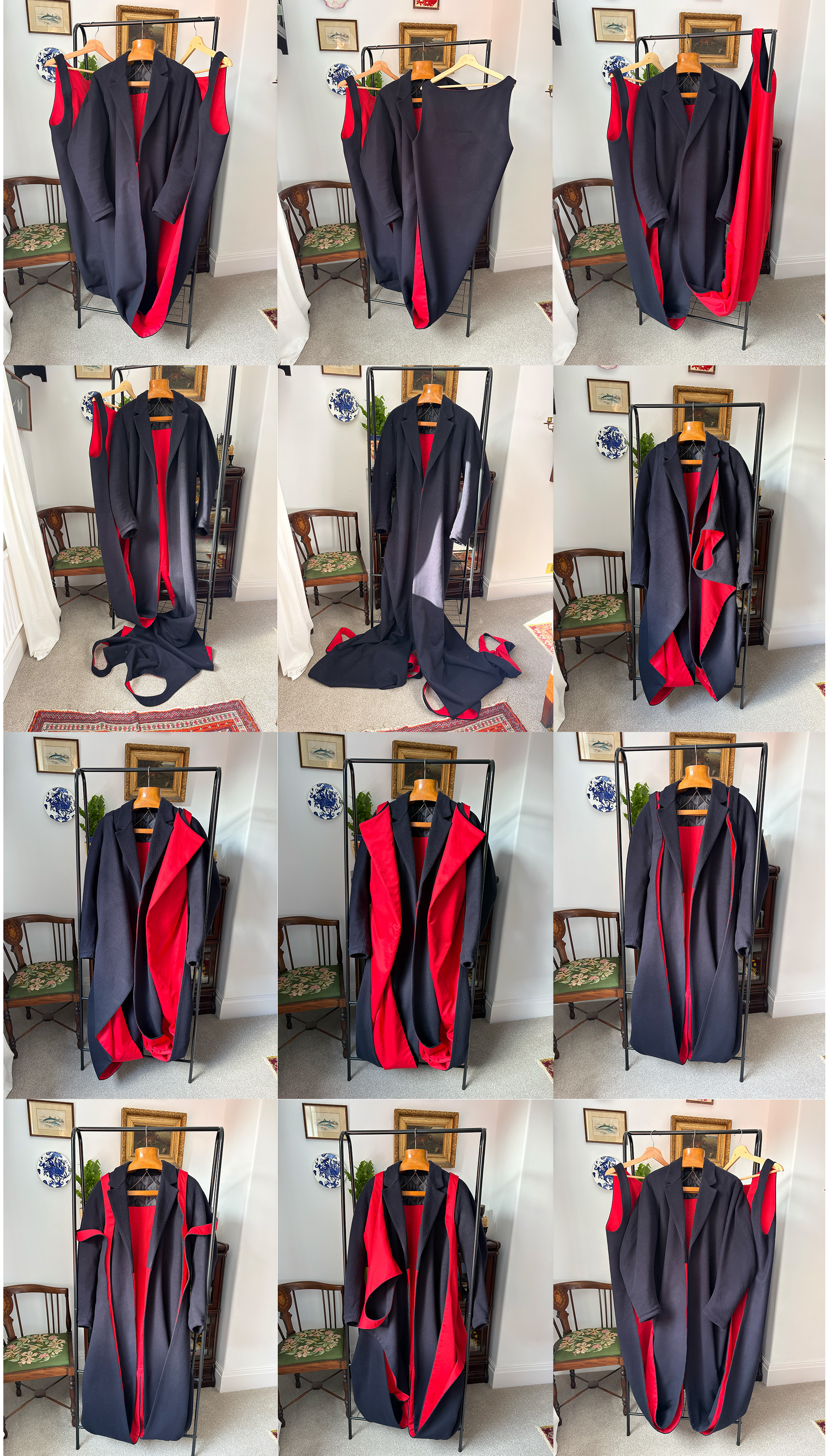
I decided to use a navy wool fabric for the outer shell of the coat and a contrasting red cotton for the lining. I used a quilted lining for the sleeve to ensure that there was no friction when wearing the coat. Pattern cutting and sewing was not complicated here, but working with such a large quantity of fabric was tricky – in all, I used 5.2 metres! I created as little wastage as possible by leaving as much usable fabric as possible for future projects. In the end, only a handful of waste fabric was generated.
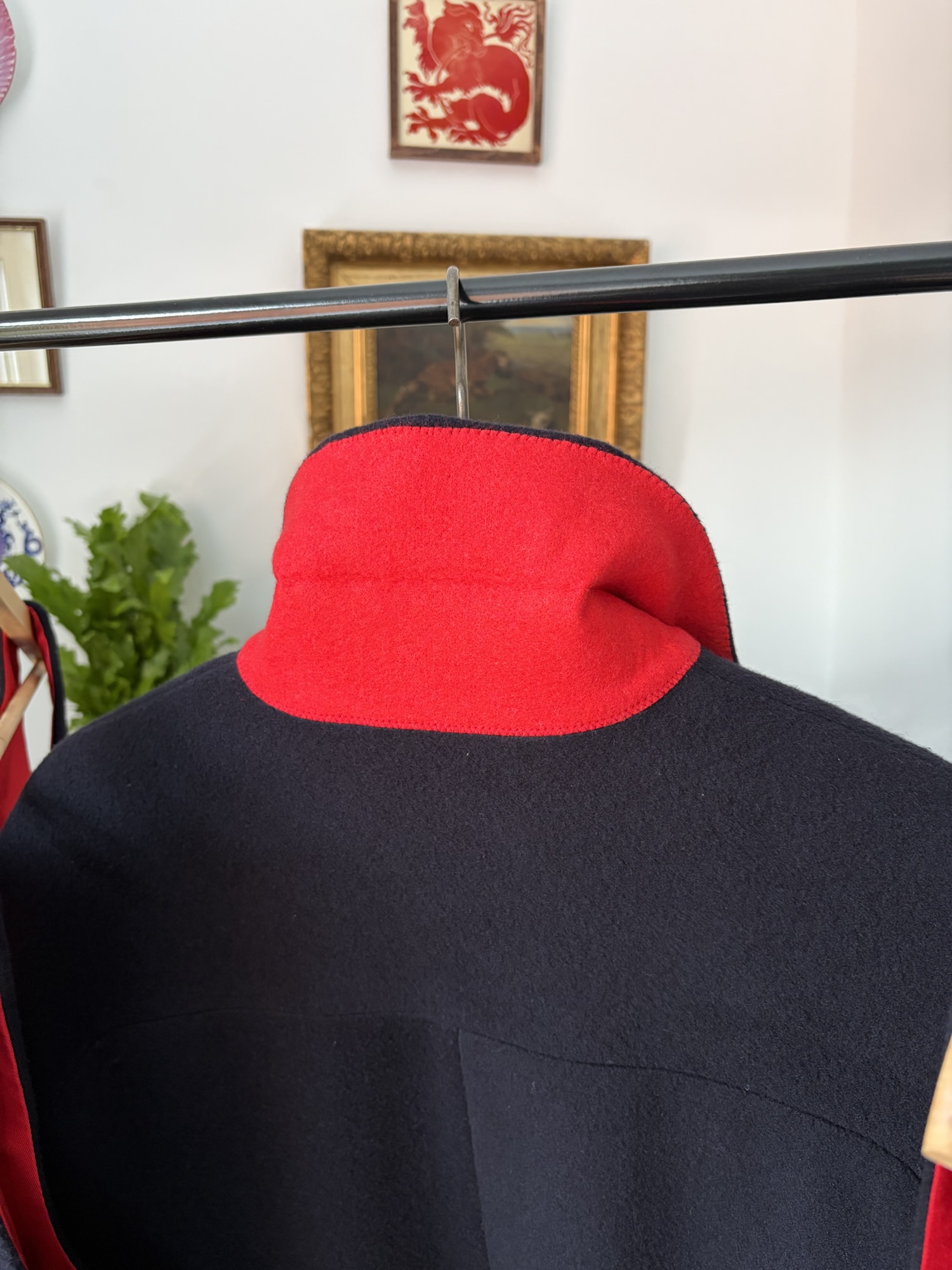
The collar for the coat was draped on a dress stand to ensure that it moulded around the neck, and the assembly used tailoring techniques including a felt under collar to ensure a professional finish. The only component that will not be included is the fastening. I decided to omit any buttons and buttonholes to keep the coat open.
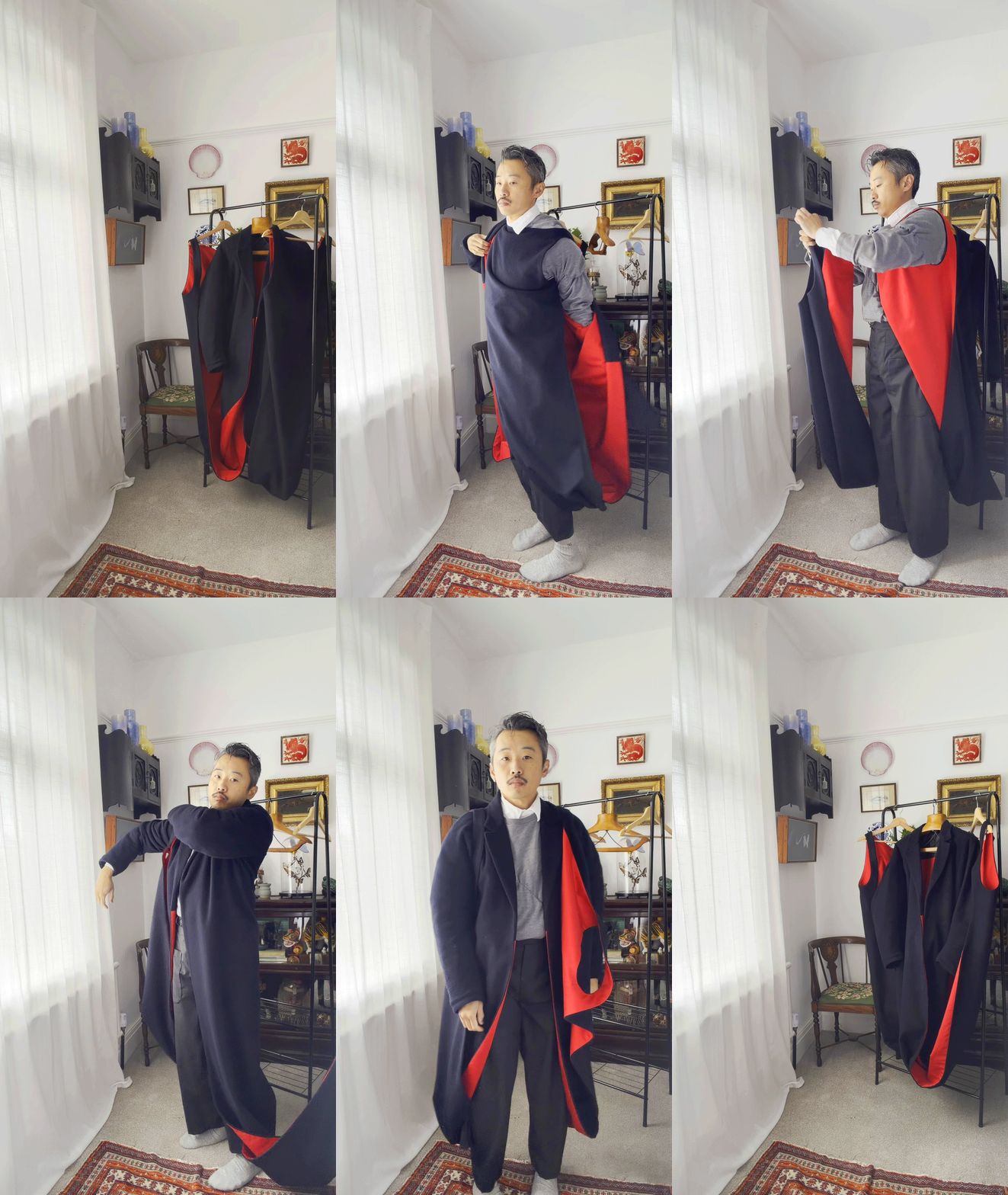
When it comes to wearing the coat, the possibilities are endless. I have tried so many ways, including twisting and turning the components, and each has created its own focal point. This is also one of the reasons why I eventually called the coat The Möbius, because the end of one pattern became the start of another, creating numerous different styling options.
So what are the answers to the questions, ‘How far do you push an idea?’, and ‘when does it end?’. Interestingly enough, these are: ‘as much as you mentally and physically can cope with’, and ‘when you decide it’s time to stop’. I have already thought of more variations to add to the patterns, and with the prospect of including modular construction (here), I can create whole fully dressed looks originating from a single piece of garment.
The problem at this moment is that I have decided to stop the experiment to give my brain a break. Thinking and visually creating scenarios in my head continues when I am asleep. This endless cycle is mentally taxing, and my body has also decided that cutting on the floor and handling more than five metres of wool on a domestic sewing machine is too tiring.
Until next time, when I recover both mentally and physically.


